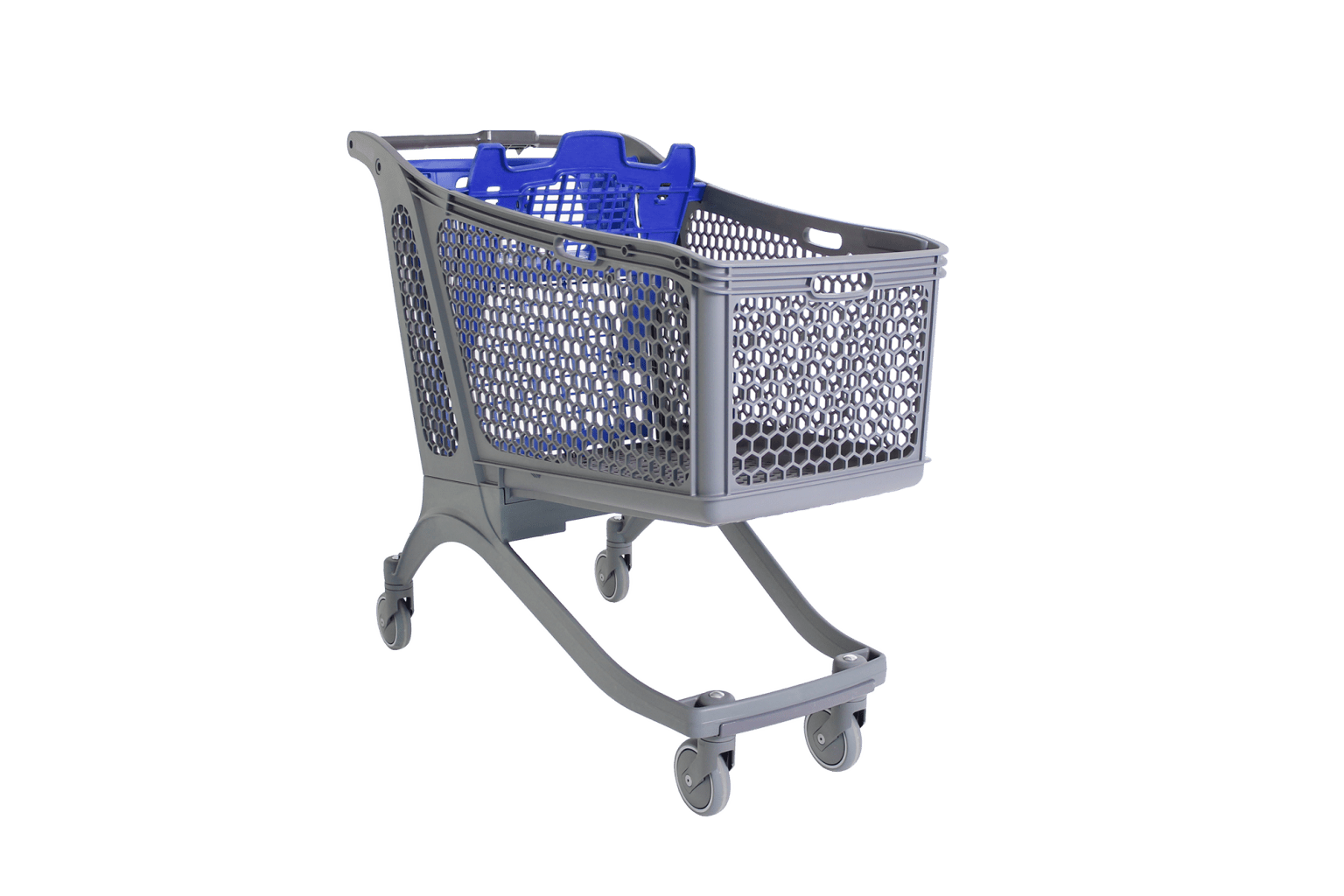
The shopping trolley or shopping cart is one of the basic elements in the equipment of stores and supermarkets, and its good condition is essential for the normal operation of these establishments on a day-to-day basis While we cannot imagine a supermarket without trolleys that allow us to move around the aisles while shopping, we may find that some of them are in poor condition (we usually notice this in their instability or difficult handling) or that there are not enough of them. So when our shopping experience can be negatively impacted, we realize the value of items that we may not place enough importance on. Considering what this problem can mean for a supermarket’s customers and therefore for the business, the question arises as to what the good condition and quality of the trolleys depends on. This brings us to the next question: What materials or processes are they made from? What kind of companies are responsible for the manufacture of this well-known product?
In order to go deeper into these questions, we must make a distinction between the two main types of supermarket trolleys since the manufacturing process of each is quite different: the metal trolley and the plastic trolley. In this post, we will focus on detailing the manufacture of the plastic trolley, whose presence has increased significantly in the last decade, becoming an alternative to the traditional metal shopping trolley.
Table of contents
Plastic shopping trolley vs Metal shopping trolley

The manufacture of the metal trolley is an industrial process through which steel processing companies create different shapes from this material by means of mechanical bending, curving and welding processes. When the desired shape is obtained for the parts that make up the trolley, these are subjected to so-called electrolytic baths. This process consists of immersing the metal part in an electrolytic solution, in which thin layers of a metal element, such as chromium or zinc, are adhered to the immersed steel part, giving the metal greater durability and a better aesthetic finish.
The manufacture of the plastic trolley, on the other hand, requires a completely different kind of industrial structure and procedures. To begin with, the production of the component parts depends on the manufacture of matrixes or moulds that will delimit their shape. In addition, specialized machinery is required, such as plastic injection moulding machines. In order to understand this manufacturing method, the transformation process of plastics must be understood.
Moulds and plastic injection moulding
As mentioned above, the manufacture of plastic parts in large volumes requires the development and construction of matrixes or moulds, which are the tools used by the industry to establish the geometry, size and characteristics of these parts. Basically, they are metal tools (steel or other alloys) with an inner cavity which defines the shape that the product will have according to the established design.The mould consists of two main parts that fit together so that it can be opened and closed during the injection process: a movable part, called “male”, and a fixed part, called “female”, which allows the pieces to be extracted.
These moulds are used to obtain plastic products using different processing techniques. The following will briefly describe the injection molding technique, through which the parts that make up the plastic trolley are obtained.
Injection moulding
Injection moulding is the process of shaping a piece of plastic by introducing (injecting) molten plastic into the mould cavity, then cooling the material and releasing the resulting part in a solid state. In order to carry out this process, it is necessary to use injection moulding machines, which may have different tonnage or capacities depending on the part to be manufactured.
Among plastic processing companies, there are those that cover the production of plastics from the mould manufacturing phase to the injection of parts, which is known as comprehensive production. On the other hand, there are companies whose structure is designed to carry out one of the phases of the process, such as injection of parts from moulds built by another company.
Manufacturing steps of plastic shopping trolleys
As simple as an item such as the plastic shopping trolley might seem, the process of comprehensively manufacturing plastic parts requires a complex industrial structure. The following is an analysis of what this production consists of, using as an example the plastic shopping trolley manufactured by ITM under its brand Polycart and dividing the manufacturing process into 5 different steps, from design to obtaining the final ready-to-use product.
Step 1. Product and mould design
The first step is to make a 2D sketch of the product, in which all the parameters and measurements will be taken into account, which will be delimited according to the features desired for the product. These features are focused, on the one hand, on user comfort i.e. the height of the trolley, and utility (the volume and capacity of the trolley, handling, etc.); on the other hand, the design is conceived according to other aspects that extend beyond the product and involve other processes, such as the optimisation of logistics and transport. For example, the nesting distance between the trolleys, in order to reduce the need for space in storage and transport. In this process, the accessories and components that will be part of the trolley, such as the child seat, the rear gate or the crate holder will also be designed.
As this shows, the design of this type of article requires a comprehensive vision that takes into account all the areas and scenarios in which the product will be involved, not only its use.
Once these parameters are defined, the 3D design is created, showing what the product will look like. When this design is ready, it is time to start designing the moulds for each of the trolley’s components. As in the previous step, the 2D mould design is created, this time according to the measurements and parameters that have been established in the trolley design phase. The mould is then designed in 3D and then starts the manufacturing process in the tooling workshop.
Step 2. Mould making
Once the product and the moulds of the component parts have been designed, it is time to manufacture these moulds from a steel block. At this point, it is necessary to consider aspects such as the plastic resin to be used, or the specifications that each injection machine has, since all this will affect the construction of the mould.
Specialised machining centres are required to produce the moulds: automated machines that perform various operations, such as milling and turning, which will be used to model the mould cavity in the steel block into the shape of the corresponding part, as well as to carry out the relevant adjustments. Later, during injection, this cavity will be filled with molten plastic.
During the mould machining process, it is also necessary to create the automatisms and sequences that will allow the correct extraction of the parts at the moment of injection.
Step 3. Placement of the mould in the injection moulding machine
When the mould is ready, it must be transported to the injection moulding machine and placed inside it, ensuring that it is properly coupled. The moulds used to manufacture the main components of the trolleys (the basket and the chassis) can weigh more than 15 tonnes, so this is a delicate process that involves heavy machinery and therefore skilled personnel.
As the video below shows, the mould is transported by means of a 64T capacity overhead crane, and then introduced and coupled to the corresponding injection moulding machine.
Step 4. Injection of components
Before explaining the injection moulding process, it is worth mentioning that Polycart
plastic trolleys are mainly made of polypropylene (PP) and polyamide or nylon (PA). PP is ideal for components such as the basket and other accessories, as it is a flexible, resistant material that provides a great lightness to these parts, while the chassis or lower structure is made of polyamide reinforced with fibreglass, as this part carries most of the weight and requires a more rigid material.
The following is an overview of the injection process:
First, the plastic material in granular form is fed into the injection moulding machine through a funnel or hopper and is deposited in the injection barrel, which is equipped with heating elements that heat it and melt it. The molten plastic is conveyed forwards through the barrel by the spindle, a rotating screw that pushes the material towards an opening or nozzle at the end of the barrel. At this point, the screw presses the material into the cavity of the closed mould. Once the corresponding quantity of plastic has been introduced, it is rapidly cooled by the mould’s cooling system, which allows it to solidify. Finally, the movable part of the mould is disengaged, leaving it open so that the resulting part can be picked up.
In order to produce large parts such as the basket or the chassis of ITM’s Polycart P240 trolley, it is necessary to use an injection moulding machine with a high clamping force, i.e. the clamping unit, formed by the plates that make up the machine’s mechanical press, must exert enough resistance to the pressure exerted by the screw when it introduces the material into the mould cavity. This ensures that the mould is tightly closed and avoids possible leaks or damage to the parts, or even damage to the mould itself. Injection moulding machines with a clamping force of up to 2,700 tonnes are used to manufacture some of the components for ITM’s plastic trolleys, which are sourced from leading manufacturers in the industry such as BMB o Krauss-Maffei.
Step 5. Assembly
Once all the components have been manufactured, the parts are assembled by hand to obtain the final product. As mentioned at the beginning, all these pieces are conceived with the product in mind from the design phase, so they are considered as accessory parts of the same product, with a uniform finish and quality.
The first step in assembling the shopping trolley is the fitting of the 4 wheels, which come from reference manufacturers such as Tente or Mecanarte. Subsequently, the chassis will be attached to the basket by means of screws and plugs designed specifically for this purpose. This semi-finished product is taken to another location within the facilities, where the rest of the components and accessories will be placed: the rear gate, the handle, the crate holder, the separator tray, etc.
Thus, the ITM’s Polycart plastic shopping trolley has been completed. A simple, quotidian product that nevertheless involves complex manufacturing processes and requires a solid industrial structure.